

A cervical specimen label may leave out the detail that determines an extraction pairing: the collection medium. Laboratories assessing an HPV test kit need to resolve that detail before treating preparation and amplification as a workable combination. A specimen name identifies the submitted material, but the medium and product configuration can qualify how it enters testing. Selection therefore starts with the actual submission and follows the pairing through to the required molecular output.
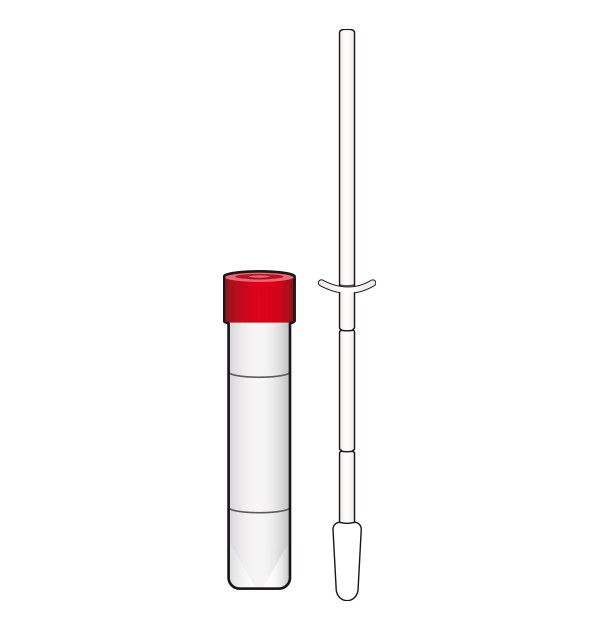
Describe Both the Specimen and Its Collection Medium
Material from the same anatomical site can arrive in different laboratory forms. A cervical swab and a liquid-based cytology specimen retain different collection descriptions, even though both may contain cervical cells. The original material and its surrounding medium jointly define the preparation problem; an anatomical label alone leaves part of that problem unspecified.
An HPV DNA test kit assessment can distinguish the accepted specimen category from the medium named in the preparation claim. ThinPrep and BD SurePath identify particular cytology media in the relevant product information. Their presence in a specimen description provides a specific condition to check, rather than a general assurance that any cervical collection fluid has the same suitability.
The proposed HPV test kit consequently needs a specimen list that matches the laboratory’s actual submissions. A record of the collection description allows an unfamiliar material to be identified before it is assigned to a familiar preparation route. This is a scope check, without specifying a new collection device, transport interval or sampling procedure.
Locate the Interface Between Extraction and Amplification
The material entering extraction differs from the DNA-containing input delivered to PCR. DNA retained during purification becomes the template, together with any surrounding components left in the recovered preparation. Collection medium belongs at that interface because it accompanies the cellular material into the preparation under assessment.
A suitable extraction pairing concerns more than the ability to obtain some DNA. Recovery, remaining interference and the form of the output all bear on the subsequent molecular examination. A measurable extract therefore supplies evidence about preparation only when its intended analytical destination remains part of the assessment.
Compatibility information needs the identities of both the preparation products and the receiving assay. A broad statement about other extraction products does not establish that every possible reagent, instrument and programme combination has already been examined. The laboratory’s proposed configuration remains a concrete object to verify against the applicable product instructions.
Read NW and NWO Pairings Within Their Stated Cytology Scope
Catalog distinctions can encode a preparation condition rather than a change in the specimen’s anatomical origin. For liquid-based cytology specimens, extraction compatibility depends on the collection medium and kit configuration. Removing that context would turn a specific liquid-based cytology pairing into a rule about all cervical material.
Liquid-based cytology pairings distinguish configurations of the BioPerfectus Human Papillomavirus Real-Time PCR Kit. For ThinPrep and BD SurePath specimens, JC80402-NW-50T pairs with DNA extraction kit SDK80120 and SSNP-series or SMPE-960 automatic extractors. JC80402-NWO-50T is compatible with other nucleic acid extraction products, retaining the need to establish the particular proposed pairing.
For an HPV DNA test kit comparison, that qualification prevents two different overextensions. The listed liquid-based cytology conditions do not become a universal restriction on cervical swabs, and the alternative configuration does not validate every conceivable extraction arrangement. Cervical swabs still require an applicable preparation procedure; the specific condition for liquid-based cytology has a narrower scope.
Check What the Matched Configuration Will Report
A preparation pairing can be appropriate while the assay’s reporting scope remains unsuitable for the requested examination. The laboratory therefore still needs to establish which HPV types the test covers and which findings it distinguishes. Specimen compatibility answers an entry question; it does not define the information returned after amplification.
The BioPerfectus assay qualitatively covers 18 HPV genotypes and reports HPV 16 and HPV 18 separately. Those stated outputs belong beside the preparation pairing during selection. The number of included types cannot, on its own, establish individual reporting of every genotype or a quantitative measurement of viral material.
After preparation is matched, performance still needs assessment. Detection limits need their stated units and target assignments, while agreement figures need the comparison framework used in evaluation. Neither a familiar extraction configuration nor a favourable numerical value supplies every part of the evidence needed to introduce the intended examination in that particular laboratory.
Document the Configuration That the Submitted Material Will Follow
The selection record can now connect the collection medium with the applicable catalog variant and extraction arrangement. The intended PCR instrument and programme complete the proposed analytical route. Keeping these identities together makes a later substitution visible at the operation it changes, instead of leaving only an unchanged assay name in the record.
Assessment of an HPV test kit can use representative accepted submissions to examine the proposed route. For the BioPerfectus product, broad compatibility with mainstream real-time PCR instruments does not remove the medium-specific extraction question. A laboratory evaluating an HPV DNA test kit needs evidence for its actual combination of specimen, preparation and amplification conditions.
The specimen description and reagent configuration meet at the point where testing is assigned. A cytology medium leads to its applicable pairing, while a cervical swab retains the preparation requirements belonging to that route. The selected arrangement becomes reviewable when each submitted material can be followed through one clearly identified extraction and detection configuration.
